
How ChatGPT Is Transforming Content Generation for Marketers

By 2026, nearly 60% of marketing teams use AI tools like ChatGPT to draft content - not because they want to replace writers, but because they’re tired of wasting hours on first drafts. If you’ve ever stared at a blank screen for 45 minutes trying to write a blog intro, you know the pain. ChatGPT doesn’t solve creativity. It solves friction.
What ChatGPT Actually Does for Content Creation
ChatGPT isn’t a magic ghostwriter. It’s a fast, flexible assistant that handles the grunt work. Think of it like a junior copywriter who never sleeps, never gets distracted, and can produce 10 versions of a product description in under a minute. You give it a prompt - say, "Write a 500-word blog post about sustainable fashion for Gen Z consumers" - and it spits out a structured, readable draft. Not perfect. But 80% there.
That 80% is the game-changer. Instead of spending six hours on research, structure, and rough wording, you spend 45 minutes refining. The real time savings come from eliminating the blank-page paralysis that kills productivity. A 2025 survey of 1,200 content teams found that using ChatGPT for initial drafts cut their average creation time from 5.2 hours to 1.8 hours per piece.
Where It Shines: Routine, Repetitive, and Scalable Content
Not all content is created equal. ChatGPT excels at formats that follow predictable patterns:
- Email newsletters - It can turn a product update into three engaging subject lines and a body that drives clicks.
- Social media captions - Feed it your brand voice and target audience, and it generates 15 variations in seconds.
- Product descriptions - For e-commerce stores with hundreds of SKUs, it cuts drafting time by 70%.
- FAQ pages - It pulls common questions from customer service logs and turns them into clear, SEO-friendly answers.
- Blog outlines - Ask it to structure a post on "How to Choose a CRM," and it gives you a logical flow with H2s, key points, and even suggested keywords.
These aren’t fluff tasks. They’re the backbone of content calendars. When you automate the repetitive stuff, you free up mental space for the stuff that actually matters - storytelling, emotional hooks, and brand personality.
What ChatGPT Can’t Do (And Why You Still Need Humans)
Here’s the truth: ChatGPT doesn’t understand your audience. It doesn’t feel your brand’s values. It doesn’t know why your customers cry when they read your mission statement.
It can write a factually correct article about mental health, but it won’t know if your audience is Gen Z college students or working moms in rural Ohio. It can’t spot a tone-deaf phrase. It won’t catch cultural missteps. It doesn’t know that your brand voice is sarcastic, warm, or fiercely direct - unless you teach it.
That’s why the best teams use ChatGPT as a co-pilot, not the pilot. You give it structure. You give it context. You give it your brand guidelines. Then you edit like a hawk. The best content still comes from a human who knows the heartbeat of their audience.

How to Use ChatGPT Without Losing Your Brand Voice
One of the biggest fears? All content starting to sound the same. Like robots wrote it. And yeah - if you use generic prompts, that’s exactly what happens.
Here’s how to avoid it:
- Start with a brand brief - Write down three adjectives that describe your voice. "Friendly but sharp." "Professional but quirky." "No fluff, all value."
- Feed it examples - Paste in two of your best-performing posts. Say: "Write a new one like these. Keep the tone, rhythm, and structure."
- Use constraints - "Write this in under 200 words. No jargon. Use contractions. Mention "sustainability" twice."
- Iterate - If the first draft feels off, say: "Make it more conversational. Shorter sentences. Add humor."
One UK-based e-commerce brand, GreenThread, used this method to scale their blog from 2 posts a month to 12 - without hiring. Their engagement went up 34% because the content felt more human, not less.
Real-World Use Case: A Content Team That Cut Costs by 40%
In Birmingham, a small agency called Clarity Copy was drowning in client requests. They had three writers juggling 15 clients. They were burning out. Then they tried ChatGPT.
Here’s what they did:
- Used ChatGPT to draft all initial blog posts and social copy.
- Assigned writers to edit, fact-check, and add personality - not to start from scratch.
- Created templates for each content type: email, blog, Instagram caption.
Within three months, they doubled output. Turnaround time dropped from 5 days to 1.5. And they hired one part-time editor instead of three full-time writers. Their profit margin jumped. Clients noticed the quality stayed high - because the human touch was still there, just more focused.
Common Mistakes People Make (And How to Avoid Them)
ChatGPT is powerful, but it’s not foolproof. Here are the top three errors teams make:
- Using it as a replacement - Output without editing = generic, robotic, and often factually shaky. Always review.
- Not training it - If you don’t give it examples of your voice, it defaults to corporate-speak. It doesn’t know your brand unless you show it.
- Ignoring SEO - ChatGPT doesn’t automatically optimize for keywords. You still need to plug in your target terms and check keyword density.
Pro tip: Run every AI-generated draft through Surfer SEO or Clearscope. They’ll tell you if you’re missing key phrases or if the structure doesn’t match top-ranking pages.
What’s Next? The Hybrid Future of Content
The future isn’t AI-written content. It’s human-AI collaboration. Teams that win are the ones using ChatGPT to handle volume, while humans handle depth.
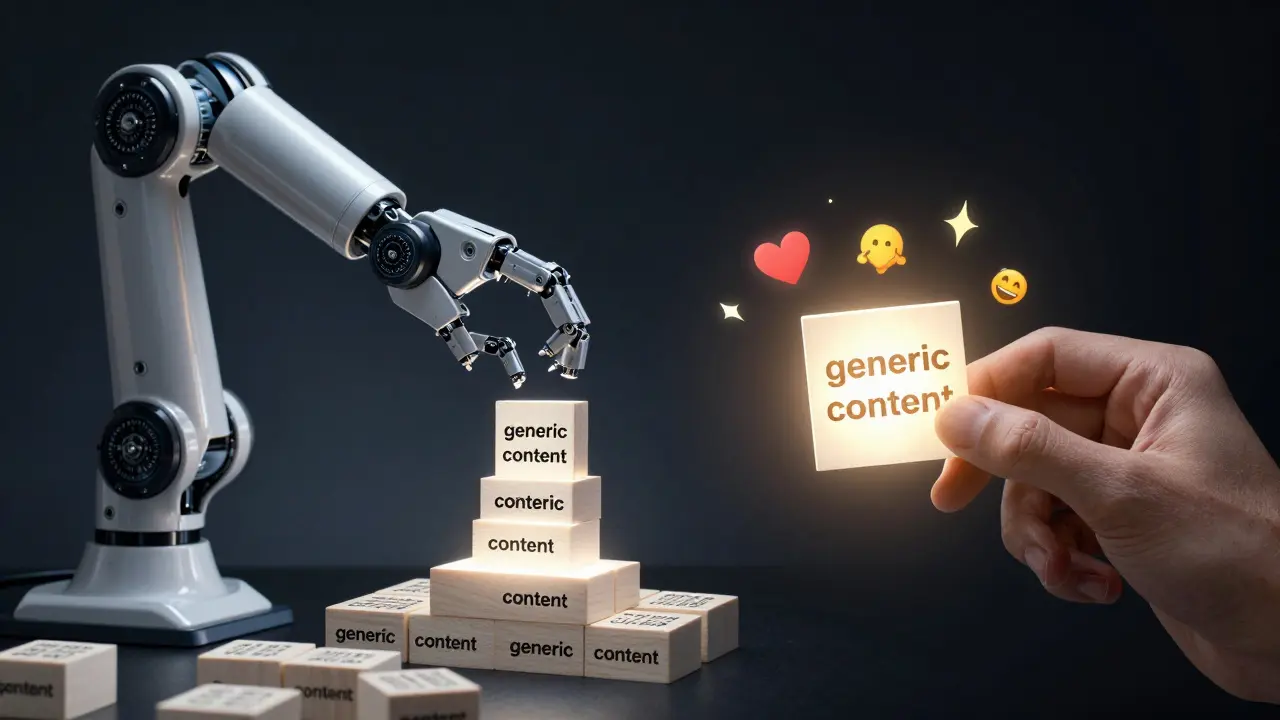
Think of it like this: ChatGPT is the factory. It produces the raw material - the draft, the outline, the variations. Humans are the artisans. They polish, personalize, and make it unforgettable.
By 2026, the best content marketers aren’t the ones who use AI the most. They’re the ones who use it the smartest.
Can ChatGPT write SEO-optimized content on its own?
No - not reliably. ChatGPT can generate content with keywords if you ask it to, but it doesn’t understand search intent the way humans do. It might miss semantic keywords, fail to match the structure of top-ranking pages, or write in a tone that doesn’t convert. Always use an SEO tool like Surfer SEO or Clearscope to audit AI-generated drafts and adjust for keyword density, headings, and content depth.
Is using ChatGPT for content considered plagiarism?
No, not if you edit it. ChatGPT generates original text based on patterns in its training data - it doesn’t copy-paste from existing articles. But if you publish its output without changes, you risk low-quality content that search engines penalize. The key is transformation: rewrite, restructure, add personal insights, and inject your brand voice. That’s not plagiarism - it’s content creation with AI assistance.
How much time can I really save using ChatGPT?
Most teams save 60-70% of their drafting time. For example, a 1,000-word blog post that used to take 4-5 hours now takes 1-2 hours - because the first draft is done in 15 minutes. The rest of the time goes into editing, fact-checking, and adding value. That’s not just time saved - it’s bandwidth freed up to focus on strategy, audience research, and campaign optimization.
Do I need to pay for ChatGPT to use it for content?
You can use the free version, but it’s limited. The free model (GPT-3.5) is slower and less accurate. For serious content teams, ChatGPT Plus ($20/month) is worth it - it uses GPT-4, which writes more coherently, handles longer prompts, and remembers context better. If you’re generating 10+ pieces of content a week, the investment pays for itself in saved labor hours.
Can ChatGPT replace my content team?
No - and it shouldn’t. AI is a tool, not a replacement. Teams that rely solely on AI end up with bland, repetitive content that doesn’t connect emotionally. The best results come from humans guiding AI: setting tone, adding nuance, fact-checking, and making sure the message resonates. Your team’s value isn’t in typing - it’s in understanding people. That’s something AI still can’t do.