
Affiliate Marketing: How to Build Real Passive Income Online
Most people think passive income means sitting back and waiting for money to show up. That’s not affiliate marketing. It’s work-smart, consistent work-that pays off months or even years later. If you’ve ever wondered how someone makes $5,000 a month selling products they never touch, this is how it actually works.
What Affiliate Marketing Really Is
Affiliate marketing is when you earn a commission by promoting other people’s products. You share a special link-your affiliate link-and when someone buys through it, you get paid. It’s not magic. It’s not a get-rich-quick scheme. It’s a performance-based system where you only get paid when you drive results.
Companies like Amazon, ShareASale, and CJ Affiliate run these programs because they want sales, not ads. They pay you only when you deliver a customer. That’s the core idea: you’re a salesperson without inventory, shipping, or customer service. The company handles everything. You just connect the dots.
How It Turns Into Passive Income
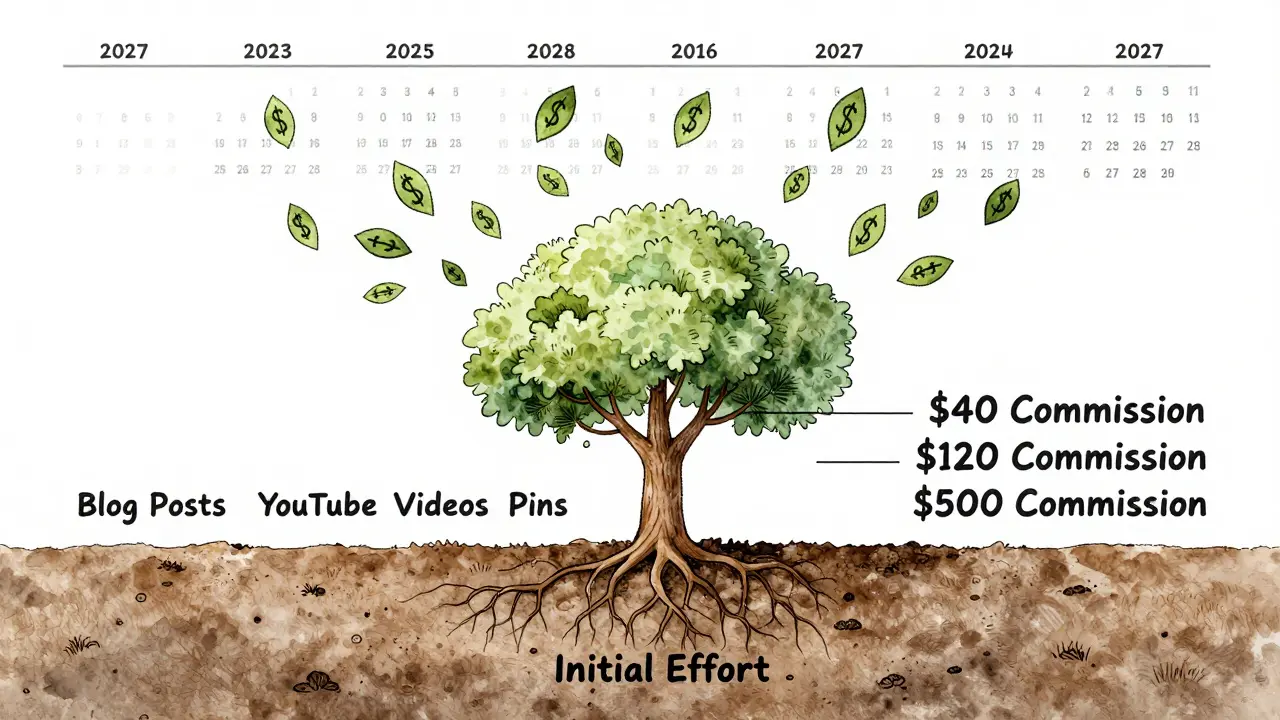
Passive income doesn’t mean zero effort. It means effort that keeps paying after the initial work. Think of it like planting trees. You dig the hole, plant the sapling, water it for a year. Then, years later, you’re picking fruit without lifting a shovel.
That’s affiliate marketing. You write a blog post, record a YouTube video, or build a Pinterest board about the best budget coffee makers. You embed your affiliate link. For the next six months, you do nothing. Then, someone searches ‘best coffee maker under $100’ in January 2027, finds your post, clicks your link, and buys. You earn $40. That’s passive. But only because you did the work upfront.
Real passive income from affiliate marketing comes from content that keeps ranking. A single blog post with solid SEO can earn you money for years. One creator in Australia made over $12,000 in 18 months from a single review of solar-powered garden lights-written in 2023. He didn’t update it. Google kept sending traffic. That’s the power of evergreen content.
Where to Start: Choosing the Right Niche
Don’t pick ‘make money online.’ That’s too broad. Don’t pick ‘fitness’-too crowded. Find a sweet spot where people are actively searching and willing to spend.
- Home gardening tools for small balconies
- Organic pet food for senior dogs
- Portable water filters for hikers in Australia
- Smart home gadgets for renters
These niches work because they solve specific problems. People in these groups are already looking to buy. They trust reviews. They read blogs. They click links. Use tools like Google Trends or Ubersuggest to see search volume. Look for phrases with at least 500 monthly searches and low competition.
Also, check the affiliate program’s commission rate. A $50 product with a 10% commission ($5) is less valuable than a $200 product with a 20% commission ($40). Focus on higher-ticket items with decent payouts. You don’t need to sell 1,000 units-just 100 good ones.
Where to Promote: Platforms That Actually Work
You don’t need TikTok or Instagram to make affiliate income. In fact, most top earners use simple platforms with long-term value.
- Blog + SEO: The most reliable method. Use WordPress. Write detailed, honest reviews. Include pros, cons, personal experience. Rank for long-tail keywords like ‘best waterproof Bluetooth speaker for beach trips’.
- YouTube: People trust video reviews. Show the product in use. Say what you didn’t like. That builds trust. A 5-minute video can earn commissions for years.
- Pinterest: Great for visual products-kitchen gadgets, home decor, gardening tools. Create pins with clear text overlays and link to your blog post.
- Email list: Build one from day one. Offer a free checklist or guide in exchange for emails. Then send occasional product recommendations. Email has the highest conversion rate of any channel.
Don’t spread yourself thin. Pick one platform and master it. A blog with 10 high-quality posts will outperform 50 TikTok videos with no traffic.
How to Find Affiliate Programs
You can’t just go to Amazon and start linking. You need to join the right programs.
- Amazon Associates: Easy to join, low commissions (1-10%), but huge product range. Good for beginners.
- ShareASale: Thousands of brands, higher commissions (often 20-50%). Great for fashion, home, and tech.
- CJ Affiliate: Big brands like Best Buy, Walmart. Higher payouts but stricter approval.
- Individual brand programs: Many companies like Ahrefs, ConvertKit, or local Australian brands have their own affiliate programs. Search ‘[brand name] affiliate program’.
Look for programs with: a 30-90 day cookie window (so you get paid if someone buys within that time), clear tracking, and timely payouts. Avoid programs that require you to buy their product first.
What Doesn’t Work (And Why)
Here’s what most beginners waste time on:
- Buying traffic: Paying for Facebook ads to promote affiliate links? Almost never works unless you’re already making $10k/month.
- Clickbait titles: ‘I made $10,000 in one day!’-people see through it. They don’t trust you.
- Promoting low-quality products: If your audience buys something broken, they’ll hate you. Your reputation is your biggest asset.
- Posting daily on social media: Unless you’re building an audience, it’s noise. Focus on content that lasts.
One person I know spent $2,000 on Instagram ads promoting a weight-loss supplement. Zero sales. He lost money. Then he wrote a 3,000-word guide on ‘How to lose belly fat after 40 without supplements’-with honest advice and one affiliate link to a trusted protein powder. Made $800 in two months. The difference? Value over hype.
How Long Until You Make Money?
Realistic timeline:
- Month 1-3: Set up your platform, choose niche, write 3-5 pieces of content. Earn $0.
- Month 4-6: Traffic starts coming. First sales. Maybe $20-$100.
- Month 7-12: Content compounds. Traffic grows. Earnings hit $300-$1,000/month.
- Year 2+: If you keep adding content, passive income hits $2,000-$5,000/month.
It’s not fast. But it’s predictable. And it scales. One person in Adelaide started in 2022 with a blog about reusable coffee cups. By 2025, he made $4,200 in a single month-just from content he wrote in 2023.
Tools You Actually Need
You don’t need expensive software. Here’s what works:
- WordPress + Elementor: Easy to build a blog without coding.
- Google Analytics: Track where traffic comes from.
- Ubersuggest or Keywords Everywhere: Find low-competition keywords.
- Canva: Make simple, clean Pinterest pins and thumbnails.
- Mailchimp (free tier): Start building your email list.
Ignore the $297/month ‘affiliate marketing courses.’ You don’t need them. The free tools are enough if you’re willing to learn and be consistent.
Final Reality Check
Affiliate marketing is not a side hustle. It’s a business. You need to treat it like one.
That means:
- Writing content even when you don’t feel like it
- Answering comments and emails
- Updating old posts to keep them relevant
- Tracking what works and dropping what doesn’t
It’s not glamorous. But if you stick with it for two years, you’ll have income that keeps flowing-even when you’re on vacation, sick, or sleeping. That’s the real power of affiliate marketing. Not the money. The freedom.
Can you make a full-time income from affiliate marketing?
Yes, but not quickly. People who make $5,000+ per month typically have 50+ pieces of content that rank on Google. It takes 18-36 months of consistent work. One Australian affiliate marketer built a site around eco-friendly baby products. After three years, he earns $8,500/month. He doesn’t work full-time anymore-he just updates content and answers emails.
Do you need a website to do affiliate marketing?
You can promote links on YouTube or Pinterest without a website, but your earnings will be limited. A website gives you control. You own the traffic. You can rank on Google. You can build an email list. Without a website, you’re relying on platforms that can change their rules overnight. A blog is your foundation.
Is affiliate marketing legal?
Yes, as long as you follow the rules. In Australia, you must clearly disclose that you earn commissions from links. Use phrases like ‘As an Amazon Associate, I earn from qualifying purchases’ or ‘This post contains affiliate links, which means I may earn a commission if you buy through them.’ Not disclosing this can lead to fines under the Australian Consumer Law.
What’s the biggest mistake beginners make?
They jump into too many programs at once. They promote 20 different products across 5 platforms. They never focus. The best earners pick one niche, one platform, and one affiliate program-and master it. Depth beats breadth every time.
How do you track your affiliate earnings?
Each affiliate program gives you a dashboard showing clicks, sales, and commissions. Use a simple spreadsheet to track which content is earning. Note the date, product, commission, and traffic source. After six months, you’ll see patterns-like which topics convert best. That tells you what to write next.
Start small. Stay consistent. Build something that lasts. That’s how real passive income is made.